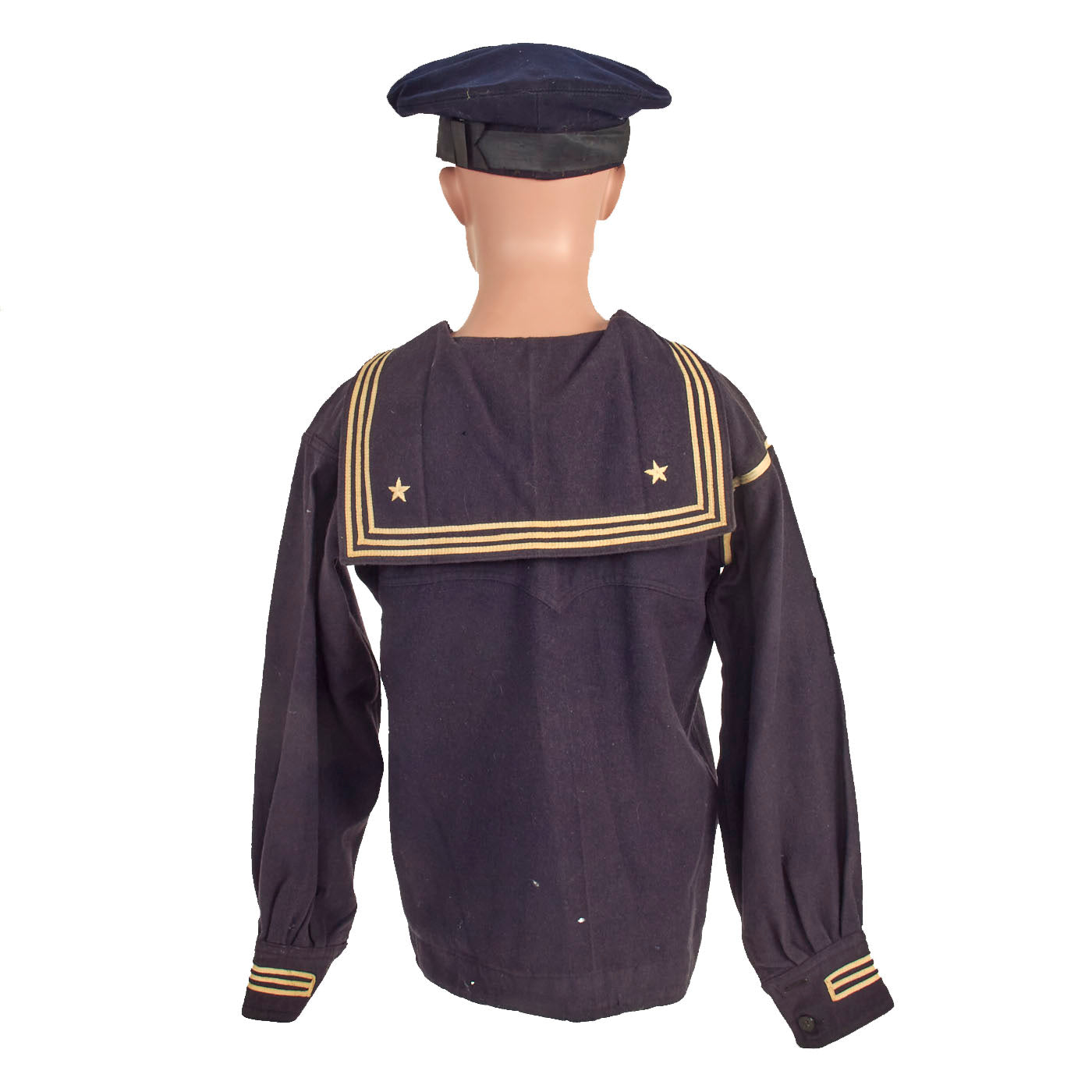
u.s. navy dress blue uniform Original U.S. WWI US Navy Gunners Mate Service Dress Blue Uniform Set –  International Military Antiques
SKU: 61724627972
u.s. navy dress blue uniform

u.s. navy dress blue uniform Original U.S. WWI US Navy Gunners Mate Service Dress Blue Uniform Set – International Military Antiques

Sale price$21.51 Regular price$23.90
Save 10%
Size: 4

Pay in installments of $5.97 with ShopPay, AfterPay and Klarna

Shipping Estimate
USA
  • USA
  • CAN

Ships within 48 hours · Estimated delivery Jun 30 - Jul 5

Promo Codes Available:

For Your Every Summer RSVP, with Code: SUMMER15

Description

u.s. navy dress blue uniform Original U.S. WWI US Navy Gunners Mate Service Dress Blue Uniform Set – International Military AntiquesOriginal Items: Only One Set Available. The US Navy dress blues have been in service for over 150 years and are still worn today. On a couple of occasions the Navy tried to replace the uniform. First, in the mid 40s, an "Ike" style uniform featuring a short jacket was tried out and was soundly rejected after its trial period. Then, between 1973 and 1980 the uniform was, in fact, briefly replaced with a more contemporary suit and visor cap design only

 Original Items: Only One Set Available. The US Navy dress blues have been in service for over 150 years and are still worn today. On a couple of occasions the Navy tried to replace the uniform. First, in the mid-40s, an "Ike" style uniform featuring a short jacket was tried out and was soundly rejected after its trial period. Then, between 1973 and 1980 the uniform was, in fact, briefly replaced with a more contemporary suit and visor cap design only to return to the tried-and-true dress blues. The uniform's main qualities of comfort, practicality, and a distinctive design have endeared it to the sailor. Iconic in appearance, the primary WW2 dress blue outfit consisted of a beret style cap with a ribbon and bow around the band; a "V" neck jumper with a square sailor's collar; a silk neckerchief; and bellbottom trousers with a 13-button broadfall front. Although its design features evolved from needs that had long since passed into history and were archaic even by WW2 standards, the uniform provided the sailor with an instantly recognizable uniform that boosted morale, evoked esprit de corps, and honored the Navy's proud history.

Photos dating back to at least the early 1860s show US sailors wearing a blue wool uniform not too different from the WW2 design. Through much of its early years the uniform was worn at sea, but by WW2 it had become mainly a dress uniform used for more formal occasions such as in formations, ceremonial activities, or for special guard duty. It was also worn on shore leave in appropriate climates. In fact, during WW2 it is most often seen being worn in northern shore and training stations by new recruits. The shift from a practical working uniform to one used for dress occasions was inevitable as military doctrine was evolving during the 1930s and 40s by setting specific roles for uniforms and establishing clear distinctions between work, garrison, and combat attire. And by the end of WW2 the age of multi-use uniforms had passed.

The dress blue jumper and trouser combination was considered a winter uniform to be worn in cool temperatures. It was constructed of high quality 16-ounce Melton wool that had a fine nap and was relatively soft to the touch. There were appropriate accessories to keep sailors warm on colder days. These included an overcoat made of matching heavy-weight Melton, blue wool knit gloves, and a blue wool muffler. The Dress Blue Uniform was included as part of the enlisted man's initial clothing gratuity. In northern training stations it was issued at induction and in warmer areas not until graduation was complete and final assignment received.

The dress blue uniform underwent continuous refinement over the decades of its use as was typically the case with uniforms that existed for any length of time. This process continued during WW2 with some significant changes being made to the jumper and trousers at the end of 1943. At this time it was decided to shorten the length of the jumper by six inches and simplify the waistband area of the trousers. These changes were implemented primarily to realize savings in a wartime economy by reducing the amount of fabric required to make the uniform and to speed up production by simplifying the manufacturing process.

The Dress Blue Uniform Items In This Grouping:
- Patched Gunner’s Mate Jumper and Trousers: The Gunner's Mate rating is primarily surface warfare-based. Closely associated Naval occupational ratings are Fire Controlman (FC), Aviation Ordnanceman (AO), Missile Technician (MT), Mineman (MN). The Gunner's Mate rating is one of the original ratings created as a result of the Naval Armament Act of 1794. The others include Boatswain's Mate (BM), Quartermasters (QM), Master-at-Arms (MA), and Yeoman (YN). The rating is also among the top five source ratings for enlisted Naval Special Warfare candidates.

The left breast features a single pinned on ribbon for the WWI Victory Medal, in wonderful condition. The right upper sleeve has a strange combination “dual rated” type of patch. The rate insignia is what appears to be a Gunner’s Mate as well as a Quartermaster, one we have not encountered before! The right shoulder has a white branch mark present. Enlisted men below the rank of petty officer wore stripes around the shoulder of their dress blue jumpers called Branch Marks. These stripes were made of ⅜-inch-wide white or red braid. Men assigned to the Seaman Branch wore a white braid on the right shoulder and men assigned to the Artificer Branch (Engine Room Force) wore a red braid on the left shoulder. Branch Marks were worn until the rank of Petty Officer was achieved, after which a Rating Badge was worn on the sleeve of the jumper. The cuff stripes indicate the rank of a Seaman 1st Class. Both the trousers and jumper are in good condition with minor moth nips and no significant damage.

- Pre-1933 USS Yorktown Flat Cap: The blue cloth cap was remarkable for its longevity having served as an essential part of the enlisted sailor's uniform for over one hundred years. During its considerable time in service, the blue cap sailed on frigates, sloops, paddle wheels, submarines, battleships, and aircraft carriers. It was present for the transition from sails to steam to fuel oil, and even lived to see the advent of nuclear propulsion. But perhaps, most of all, the cap brings back memories of great armadas, the age of Dreadnoughts, and the historic conflicts they partook in. Recorded in the Navy Uniform Regulations as early as 1833, the blue cap was originally part of an ensemble of clothing prescribed for enlisted seamen to be worn outdoors in both cold and warm weather. Early regulations simply described a "Blue Cloth Cap" until the Civil War period when the wording was slightly changed to "Blue Cloth Cap, without visor".

The circumference of the pre-1933 cap was much larger and required a wire stiffener on the inside to help keep its shape. Just like a lot of other sailors, the stiffener was removed to attribute a saltier appearance. The 1933 cap had a front riser that lifted the crown well above the ribbon. Additionally, the crown of the 1933 cap was attached to the sides using a cord seam, which is not present on this one. Prior to 1941, the vessel's name or any one of a number of different shore station designations could be displayed on the ribbon. In this case it's the Gunboat USS Yorktown (PG-1). The cap is in lovely condition and is even named on the inside with H. H. EDMAN stenciled into the top lining. Unfortunately we have not been able to locate any service information, making for a wonderful research opportunity.

This is truly a wonderful set of an early US Navy Dress Blue Uniform with a ship tallied flat cap! Comes more than ready for research and display.

Approx. Measurements:
Collar to shoulder: 9.5”
Shoulder to sleeve: 20”
Shoulder to shoulder: 17.5”
Chest width: 17.5”
Waist width: 18”
Hip width: 18”
Front length: 23.5"

Pants:
Waist:15.5"
Inseam: 28"

USS Yorktown (PG-1)
USS Yorktown was the lead ship of her class of steel-hulled, twin-screw gunboats in the United States Navy in the late 19th and early 20th centuries. She was the second U.S. Navy ship named in honor of the American Revolutionary War's Battle of Yorktown.

Yorktown was laid down by William Cramp & Sons of Philadelphia in May 1887 and launched in April 1888. She was just over 244 feet (74 m) long and 36 feet (11 m) abeam, and displaced 1,710 long tons (1,740 t). She was equipped with two steam engines which were supplemented with three schooner-rigged masts. The ship's main battery consisted of six 6-inch (15.2 cm) guns and was augmented by an assortment of smaller-caliber guns.

At launch, Yorktown joined the Squadron of Evolution of "New Navy" steel-hulled ships. Detached from that squadron, Yorktown, under the command of Robley D. Evans, sailed to Valparaíso, Chile, during the 1891 Baltimore Crisis and relieved USS Baltimore at that port. After that situation was resolved, Yorktown took part in the joint British–American sealing patrol in Alaskan waters and duty on the Asiatic Station before returning to the United States in 1898. Yorktown was out of commission during the Spanish–American War, but took part in actions in the Philippine–American War and the Boxer Rebellion in 1899 and 1900, respectively, after she had been recommissioned.

After three years out of commission from 1903 to 1906, Yorktown hosted the Secretary of the Navy on board when he greeted the Great White Fleet on its arrival in San Francisco in May 1908. Over the next five years, most of Yorktown's time was spent in sealing patrols in Alaska and duty in Latin American ports. From July 1912, Yorktown was out of commission for alterations, but resumed duties off the Mexican, Nicaraguan, and Honduran coasts beginning in April 1913. Through World War I, Yorktown continued in the same role, until she departed for the East Coast of the United States in April 1918. She served as an escort for one convoy headed to Halifax in August, and remained in coastal escort duties in the east until January 1919. After arrival at San Diego in February, she was decommissioned for the final time in June 1919, and was assigned the hull number PG-1 the following year. She was sold in 1921 to an Oakland, California firm and broke up that same year.

Recommissioned on 1 April 1913, with Commander George B. Bradshaw in command, Yorktown operated out of San Diego on shakedown into mid-April. She was soon back at Corinto, however, remaining in Nicaragua until 5 June. After a brief period of operations off the coast, she returned to Corinto on 21 June and remained there for over a month before departing on 31 July to coal at Salina Cruz, Mexico. She moved to Mazatlán on 10 August and there picked up mail, delivering it to the port of Topolobampo, Mexico, on the 11th. Yorktown remained there until mid-September.

For the remainder of 1913, Yorktown conducted local operations out of San Diego and San Francisco. In January 1914, though, the gunboat returned to Mexican waters and investigated local conditions at Ensenada between 3 and 6 January before moving, in subsequent months, to a succession of Mexican ports: Mazatlán, San Blas, Miramar, Topolobampo, and La Paz. Following an overhaul at Mare Island from 24 June to 2 September 1914, Yorktown served in Mexican waters again into June 1915. From that point until the entry of the United States into World War I in April 1917, Yorktown continued her routine of patrols off Mexican, Nicaraguan, and Honduran ports with occasional repairs at Mare Island and maneuvers out of San Diego.

After the United States joined the Allies, Yorktown operated off the coast of Mexico until August 1917, when she paused briefly at San Diego. On 18 July 1917, Yorktown rescued the last surviving members of an abandoned guano mining settlement on Clipperton Island. From a peak population of roughly 100 in 1915, only four women and seven children survived. After her time off the Mexican coast, Yorktown then cruised off the west coasts of Central and South America into 1918. After a refit at Mare Island, Yorktown, sailed for the east coast on 28 April 1918, transiting the Panama Canal en route, and arrived at New York on 20 August. The gunboat escorted a coastal convoy to Halifax, soon there after before returning to New York. She performed local coastwise escort duties through the end of World War I. After a period of upkeep at the New York Navy Yard in December, she departed the east coast on 2 January 1919 on her last voyage to California.

Arriving at San Diego on 15 February 1919, Yorktown was placed out of commission at Mare Island on 12 June 1919. On 17 June 1920, she was assigned the hull number PG-1. The veteran steel-hulled gunboat was sold to the Union Hide Company of Oakland, California, on 30 September 1921; she was broken up in Oakland sometime after that.

Shipping Notes
  • Free Standard Shipping on $100+ Orders to the USA.
  • Except Preorder products are shipped in 48 hours.
  • Delivery to the USA:
  1. Standard Shipping : 3-10 business days
  • If time is of the essence, please consider selecting expedited delivery for faster service.
Exchange/Return Notes
  • We offer a 30-day return/exchange service after receiving.
  • Final sale items are not eligible for returns or exchanges.
  • To process your return/exchange, please contact us at [email protected]
  • Please click here for more details>>> Return & Exchange Policy
SKU: 61724627972

Discover Niche Categories That Outsell u.s. navy dress blue uniform

Top-Converting Item to Boost Your Average Order

4.1 ★★★★★
Based on 357 reviews
Sort
Highest Rating
Newest First
Oldest First
Product Reviews
J
Verified Purchase
Justin Effler
New York, US
★★★★★ 5
A Pleasure To Read
Format: Kindle
Academic books are known to be dry and poorly written, with semantics used that inadvertently confuse the reader; not with this book. Mounce displays that not only does he really know his “stuff” as a scholar, but how to make the read enjoyable to the laity. I recall reading the notorious bible skeptic’s book, “Misquoting Jesus” by Bart Ehrman a number of years back and even though as a Christian who loves the Bible I couldn’t help but notice how well and enjoyable he made the book. Both Mounce and Ehrman are in the same field and understand as textual critics how to communicate to people in an manner to the lay person. I sought out this book with the understanding of how we can trust the canon and got a lot more than I thought! While, I will admit, a lot of trusting that the 27 books of the New Testament (and the Old Testament) are what they are supposed to be is a matter of trusting God in his sovereignty. He laid great groundwork for why the early church believed them and what their criterion was to accept a book as “scripture”. He also brought some important distinctions int eh church’s infancy that there was a functional canon and exclusive canon; that being from scholar Michael Kruger that he referenced. I found the section on translations very useful as it brought a balanced perspective on what it means not just translate but how to treat the text properly. One of his examples with a big criticism on the term “reading the Bible literally” when translated from one language (Greek, Hebrew and Aramaic) to another (English, etc.). We develop much of our words in translation not just by individuals words that can mean a lot of different things, but with its surrounding context. I won’t spend too much time but there were a vast amount of other important topics, like the historical Jesus, Old Testament as well as the problem of evil and other things that where quite useful to, but for me and the importance of canon is why I sought on this book. Now I am still on the journey of studying more about why this canon but a lot more clearly has come and I trust the Lord in his sovereignty in that we have preserved God’s holy books. This is a must read for any Christian apologist or just anyone who is looking to understand the Bible better.
WAS THIS REVIEW HELPFUL?YesReportShare
Reviewed in the United States on June 24, 2023
D
Verified Purchase
Dr. James Garrett
Waukegan, US
★★★★★ 5
Faithful to God's Word
Format: Paperback, Format: Paperback
I have been a fan of Bill Mounce since I was taught Koine Greek using Version 2 of his methodology. He writes in an easy-to-read style that faithfully communicates truth and facts. I was so impressed with his works that I have purchased several and have used many of his texts--even with the Greek classes that I have taught. When this new book came out, i was extremely excited because I assumed the same simple yet profound emphasis would exude from this new work. I was and am correct. Mounce, in a very positive and supportive way, takes the topic that many make controversial concerning the veracity and trustworthiness of the 66 books we know as the Bible. He has researched this project well and utilizes the collected wisdom of many modern-day scholars concerning various aspects of ancient texts and translations of the Bible. He also acknowledges and addresses some of the so-called "wisdom" of a few of the modern-day non-adherants of the Bible. I was very impressed of his handling of these critics and critiques because, as he should, he dealt with them in a very straight-forward manner--affirming their intelligence but not their findings/propositions/conclusions. I appreciate that--as a pastor, I can strongly recommend this work to adults and older teens in my congregation (all laymen) and that I can trust it as they read it. (In fact, I have already recommended it to some.) I also appreciate that--as a college/seminary professor, there is sufficient solid material here that I can recommend this to my students and that I can know they are receiving the truth concerning God's Word, In all honesty, there is probably not enough good that I can say as I recommend this great book. Dr. James (Jim) Garrett
WAS THIS REVIEW HELPFUL?YesReportShare
Reviewed in the United States on October 14, 2021
C
Verified Purchase
Catharina
Chelsea, US
★★★★★ 5
A must read book for anyone who doubts the bible
Format: Paperback
I was interested to read this book because I was already familiar with the author William Mounce having studied his book, “Basics of Biblical Greek Grammar” and knowing that he was on the oversight committees of the ESV and NIV bible translations so felt I could trust his validity. His book is based on academic research but written to a nontechnical audience which makes this a great tool to share with anyone who has doubts about the bible. With that said, I found it to be intelligent with a lot of reference material. I didn’t want to skim over any part and read it slowly so I could understand what was being said. One of the reasons people doubt the bible is they say there are contradictions and errors. There are 2 chapters regarding apparent contradictions. With each contradiction, he addresses it with facts and gives clarity to what could seem confusing. Other chapters teach on the Historical Jesus, The Canon – how we got 27 books in the NT, Textual criticism, Translations and The Old Testament. I found this book to be very informative and interesting, one I will keep going back to for reference.
WAS THIS REVIEW HELPFUL?YesReportShare
Reviewed in the United States on October 31, 2021
P
Verified Purchase
Poole
Massapequa, US
★★★★★ 5
Excellent Read!
Format: Paperback
William Mounce always has a way with bringing things to light clearly, just read his Greek text books and you will see that. His new book “Why I trust the Bible” answers a very important question for Christians. We are to be people of the book, and today many try to cast doubt on God’s words. These attacks on the Word of God come from both the left and right of the issue, atheist and the KJV only crowd. Mr. Mounce handles the issues with clear and accurate facts. From the reality and deity of Jesus Christ to the reliability of canon we call scripture. Does he have a biased? If he does he tells you, but he also is very pointed at the goal, showing I CAN trust the bible. “Why I trust the Bible” is a great read if you want the facts but don’t want to spend hours reading the arguments in multiple books or websites. Mr. Mounce provides the evidence and the tools for you to dig deeper and see where and what was said for yourself. I would highly recommend this book as the issue is handled very concisely and with great clarity.
WAS THIS REVIEW HELPFUL?YesReportShare
Reviewed in the United States on September 14, 2021
J
Verified Purchase
Jung
Omaha, US
★★★★★ 5
It argues for the reasons for helping the poor and provides ways to do so with helpful examples.
Format: Kindle
In Chapter 1 “What is Doing Justice?” Keller says just as tithe is the right or due of the priests, the poor and needy have rights to have their needs met. Any neglect shown to their needs is not called merely a lack of mercy or charity but a violation of justice. The Bible introduces God as a father to the fatherless, a defender of widows (Psalm 68:4-5). Giving justice and defending to the poor and weak is one of the main things he does in the world. He identifies with the powerless and takes up their cause. Because most of the oppressed are those who are poor and powerless, God gives them particular attention and has a special place in his heart for them. Justice is more than merely giving the poor small, perfunctory gifts, but turning the their life to a life of delight. Justice includes generosity. In Chapter 2 “Justice and the Old Testament” Keller says Jesus has fulfilled the ceremonial laws of Moses, including clean laws of touching, diet, dress; sacrificial system and temple worship ordinances. However, the basic principles in the Old Testament remain the same. Christ only changed the way in which Christians exhibit their holiness and offer their sacrifices. Today, people are required to offer God their entire lives as sacrifices (Romans 12:1-2), as well as the sacrifices of worship to God and the sharing of their resources with others (Hebrews 13:5). Although the Bible does not guarantee that no one will ever fall into poverty, God promises that He will richly bless His people so that if they are kind and good to the needy around them by being openhanded and freely lending everything he needs, there would not be a poor man among them, that no one will suffer from permanent, long-term poverty. The money we have is as much a gift of God as the manna was a gift to the Israelites in the desert. The Biblical laws for the use of land criticize the statism that disregards the precious treasure of personal rootage as well as the untrammeled individualism which secures individuals at the expense of community. The three causes of poverty, according to the Bible are oppression, calamity, and personal moral failure. Taken in isolation no one factor – government programs, public policy, calls to personal responsibility, or private charity – is sufficient to address the problem. In Chapter 3 “What did Jesus Say About Justice?” Keller says Jesus wants his followers to be profoundly generous to the poor, spending more money on them than on the rich and the friends. Genuine concern for the poor is not a means of getting salvation but rather the sign that you already have salvation. Whatever a person does to the poor is done to Jesus. The Bible sees sexual immorality and material selfishness as both flowing from self-centeredness rather than God-centeredness. Gospel preaching that targets some sins but not the sins of oppression cannot work among most people in the world, people who are poor peasants and workers. Our first responsibility is to our own families and relations (1 Timothy 5:8), and our second responsibility is to other members of the community of faith (Galatians 6:10). However, our responsibility also includes doing good to all people, including strangers such as foreigners. In Chapter 4 “Justice and Your Neighbor” Keller says Jesus said that loving God and neighbor is the way to get eternal life. To this, the expert in the law asked who his neighbor is. Using the story of good Samaritan, Jesus says that anyone in need is our neighbor. We should not refuse to help others by saying that they are not yet in extreme poverty because we would not wait until we are in extreme poverty before doing something to alleviate our suffering. We should not say I cannot help anyone because we mean I cannot help anyone without burdening myself, cutting in to how I live my life. We should not refuse to help others because they are ungrateful and wicked because Jesus saved us not even though we are ungrateful and evil people. We should not refuse to help the poor who fell into poverty because of their own selfish, indolent, or violent behavior unless they continue in those evils. Even if they do persist in the same evil, we should still help the family members of those evil people. Jesus is the great Samaritan who came down and saved us out of his compassion on us, the spiritually dead. In Chapter 5 “Why Should We Do Justice?” Keller says two basic motivations for doing justice that the Bible gives are first joyful awe before the goodness of God’s creation and second the experience of God’s grace in redemption. The fact that humans are created in the image of God shows that every human being deserves respect. God gave to humans management and authority over the earth but not the ownership. God gave the poor the right to receive favor and good will from the rich as the rich have received favor and good will from God. A person who experienced of God’s grace can no longer have pride and haughtiness and aloofness toward the poor. In Chapter 6 “How should we do justice?” Keller says doing justice requires constant, sustained reflection and circumspection, thinking through how to do justice in every area of life.Vulnerable people need multiple levels of help. Keller call these layers relief, development, and social reform. Relief is direct aid to meet immediate physical, material, and economic needs. Development is giving an individual, family, or entire community what they need to move beyond dependency on relief into a condition of economic self-sufficiency. When John Perkins explained his philosophy of ministry, he always named three basic factors. One he called “relocation,” though others have called it “reneighboring a community.” This means the helper should live within the community and thus have firsthand knowledge of the needs of the neighborhood and real accountability to the residents. Perkins also spoke of “redistribution,” something others have called “reweaving a community.” This means that financial capital, social capital, and spiritual capital that are invested into the community should stay within the community for the benefit of the community. By “financial capital,” we of course mean the ability to attract businesses that not only provide goods for customers, but also keep wealth and financial capital in the community itself. By “social capital,” Perkins meant the training and retaining of local leadership. “Spiritual capital” refers to the spiritual and moral influence of the churches in the neighborhood. There is a third important factor in John Perkins’s strategy for rebuilding poor communities. He names it “racial reconciliation.” This includes empowering the resident of poor communities to control their own destiny as well as inviting professional helpers from outside to play a role. The new bonds with others in Christ are stronger than our relationship to other members of our own racial and national groups. The gospel gives believers critical distance from their own culture, enabling them to critique their own cultural idols. When these new insights are established in the consciousness of a Christian, a church, and a community, the resulting unity of relationships becomes both a means to reneighboring and reweaving and a direct witness to the world of the reality of the gospel. Besides relief and development (both individual and corporate) there is social reform. Social reform moves beyond the relief of immediate needs and dependency and seeks to change the conditions and social structures that aggravate or cause that dependency. Doing justice and generosity should not be the means to evangelism nor be considered the same thing as evangelism nor be considered something detracts from evangelism. Instead, they should exist in an asymmetrical, inseparable relationship. Doing justice and generosity is inseparably connected to preaching the gospel because the gospel produces love and concern for the poor and the deeds of justice and generosity give credibility to the preaching of the gospel. In other words, justification by faith leads to doing justice and generosity, and doing justice and generosity make many seek to be justified by faith. The most loving thing anyone can do for one’s neighbor is to help him or her to have a saving faith in God, to have a saving relationship with Him that will result in eternal life with Him. Christian church, like any other institution or organization, cannot do all things well, and thus should do the work of relief and some development inside and around its community for their own members, neighborhoods and cities and let its members to do the work of development and social reform through appropriate organizations and institutions. In Chapter 7 “Doing Justice In the Public Square” Keller says there is no consensus on what justice is. People assume the other side know they are simply being unjust, but the reality is nearly everyone thinks they are on justice’s side. Justice is not a matter of common sense because people have differing opinions about what freedom and equality, what things that define justice, are. The causes for which justice is invoked are always matters of deeply held beliefs, rooted in particular view on matters of faith such as human nature, happiness, right, and wrong. There are competing visions of justice in our society which can fall into three categories: maximizing welfare, respecting freedom, and promoting virtue. Attempt to talk about justice in the supposedly neutral terms of freedom and equality that we can all agree on did not work because our ideas of justice are rooted in views of life that are nonprovable faith assumptions. The forbiddance to bring religious beliefs into public argument has made debate or discourse over normative matters barren, unsatisfying, and shallow. We can’t agree on what justice is because we are not allowed to talk about our underlying beliefs publicly. We are locked in endless disagreement, largely because we live with the illusion that we can achieve moral and religious neutrality. Many great political and influential figures in the past used religious language to argue for their cause. Prohibition of bringing personal morality into public policy is thus absurd. Our law is itself a codification of morality, much of it grounded in the Judeo-Christian tradition. Although Christians should not be strident and condemning in their language or attitude, Christians should not be silent about the Biblical roots of their passion for justice. Christians’ work for justice should be characterized by both humble cooperation and respectful provocation. Common grace of God gives skills in science, scholarship, crafts, government, art, and jurisprudence to nonbelievers as well. Christians and non-Christians have common values that can form a connection between them. Believers should let their coworkers know of how the gospel is motivating them, yet also they should appeal to common values as much as possible. At the same time, they should be respectfully provocative with them, arguing that their models of justice are reductionistic and incomplete. Christians should talk about how their beliefs are different than those of non-Christians even if they have the same basic social goals. Valuing things is always based on beliefs about the purposes of life, human nature, right and wrong, all of which are moral and religious. As Aristotle and other Greek philosophers reasoned, unless we can determine what human beings are here for, it is impossible to determine how we should live. Many prominent thinkers and scientists say that human being does not have inherent worth. Therefore, even atheist and agnostic philosophers acknowledge that the concept of human rights requires a religious dimension. Many nonreligious people believe in human dignity and human rights. However, it is just that any such belief is religious in nature. In Chapter 8 “Peace, Beauty, and Justice” Keller says the Jewish description of the creation is unique in that God created the world as a craftsman or an artisan with much care and planning. God created all things in an interdependent, harmonious relationship to one another. Just as rightly related physical elements form a cosmos, so rightly related human beings form a community, and this interwovenness is what the Bible calls shalom, or harmonious peace. Shalom means peace resulting from right, perfect, and joyful relationship in all dimensions – physical, emotional, social, and spiritual. When there is crime, poverty, and family breakdown, there is no shalom in the society. However, when people share with others, work together for good and functional public services, school, and flouring businesses, the community experiences shalom. Broken relationship with God resulted in war, crime, family breakdown, oppression, injustice, hunger, sickness, aging and physical death. Doing justice means bringing shalom to the community, especially for the poor and the weaker members of the society. Perceiving the goodness of God in His sacrificial love makes doing justice and other things that honor and please God a delight to people. God identifies with the poor not only symbolically but also literally in the incarnation and death of Jesus. He had little the world valued and the little he had was taken. Though He was rich, for the sake of us He became poor, so that we through His poverty might become rich (2 Corinthians 8:9). In section titled “Justice Includes Generosity” in chapter 1, “What is doing Justice?”, the author seems to say that generous giving to the poor is a requirement from God. Mercy, compassion, or charity are not a requirement, but justice is. Therefore, generous giving must be justice, and justice unconditionally includes generous giving. Thus, the author equates justice with generosity or generous giving of time and resources. The author went further by saying that those who do not actively and generously share their resources with the poor are robbers. I must disagree with what the author said above. When generous giving to the poor or generosity becomes justice, it means the rich have the legal obligation to give to the poor, and the poor have legal right to demand goods from the rich or even take goods from the rich without their knowledge. When the rich accuse the poor of stealing from them, the poor would be able to say “It is justice for us to receive generosity from you. Therefore, it is not stealing but merely exercise of justice and practice of our rights.” Instead of calling generous giving to the poor justice, I believe generous giving to the poor is a righteousness. It is a righteousness that God demands from the rich. However, God did not give the poor the right to demand or steal from the rich. God merely gave the poor the right to ask for what they need from the rich, and the right to receive from the rich whatever the rich give them. If mercy, compassion, and charity to the poor by the rich are a requirement, an obligation on the part of the rich, some people may argue that generous giving to the poor can no longer be called mercy, compassion, or charity by the rich. I think they have a solid ground to argue that case, but indisputable truth that remains unchanged is that the generous giving to the poor through the rich is mercy, compassion, and charity by God. The author said, “We do justice when we give all human beings their due as creations of God.” It is equally true to say, “God does justice when He gives all human beings their due as creations of God.” Then when the poor receive goods, or rather when human beings receive life, health, wealth, and peace from God, are they receiving their due from God? If so, human beings do not have to give thanks to God because they are only receiving their due from God and God merely doing what His Justice requires Him to do. I agree with what Keller said regarding what Christians should do to help the poor. I could feel the enthusiasm he has for helping the poor while reading the book. I also give due respect to the efforts he has made. It seems to me he has done appropriate research for writing on this subject. He has proposed well-thought-out ways to help the poor. His mention of inputs from many other people, particularly those from Abraham Kuyper and John Perkins, were especially helpful. These various inputs helped considering the task of helping the poor in a more balanced and multifaceted way. Most importantly, he has a first-hand experience of helping the poor which gives him invaluable knowledge and know-off from which he can draw and helps him critically assess the benefits and shortcomings of inputs from others. I believe more improvements can be made upon the helping ministry that he and others have built upon. However, due to lack of first-hand experience, it is difficult for me to propose any valuable improvements.
WAS THIS REVIEW HELPFUL?YesReportShare
Reviewed in the United States on June 17, 2021

recommand products